Starbucks: From Pike Place to your London postcode
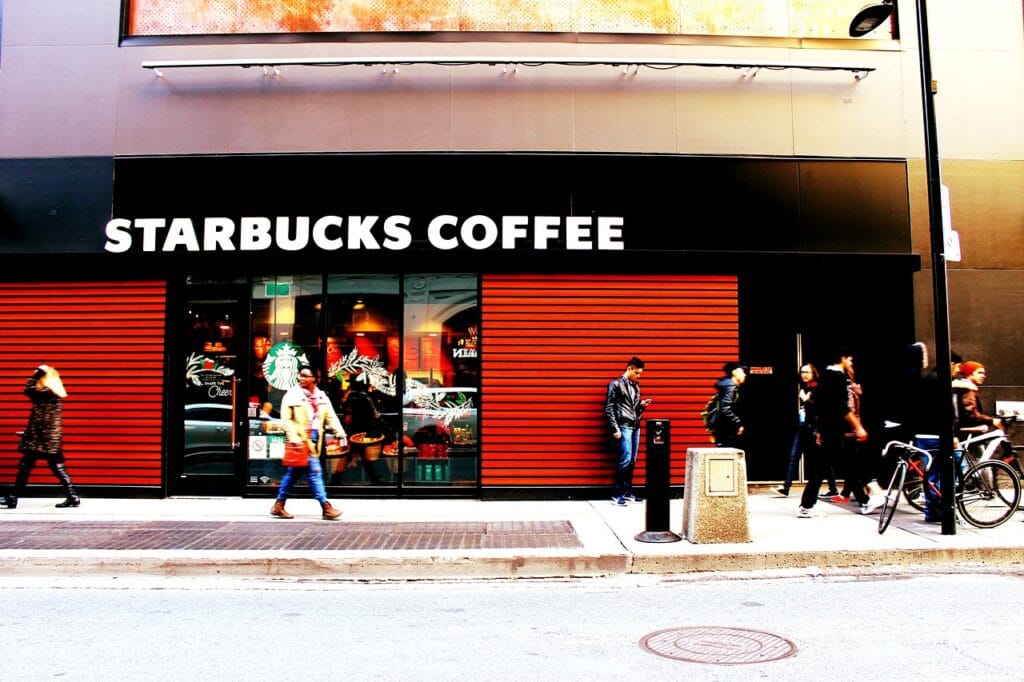
Today, it is almost impossible to walk through central London without passing a Starbucks coffee shop.
whether you are near Oxford Circus, Shoreditch High Street, or a suburban station. Starbucks has become part of the fabric of urban life, shaping how Londoners socialise, commute, and even work remotely.
At the same time, the UK’s taste for quality roasted coffee has soared, with over half of coffee purchased in 2024 being roast rather than instant, underlining the shift towards premium experiences (Lavazza Professional, 2026).
As more Londoners search “coffee near me” on their phones, Starbucks is often the convenient, recognisable answer. However, behind your daily latte lies a fascinating story of brand-building, expansion, and a growing focus on sustainable coffee that increasingly matters to style-conscious, ethically minded consumers.
The origins of the Starbucks Coffee story
A small shop in Seattle’s Pike Place Market
Starbucks began in 1971 as a single store in Seattle’s historic Pike Place Market, founded by Jerry Baldwin, Zev Siegl and Gordon Bowker to sell high-quality coffee beans and equipment rather than brewed drinks (Wikipedia, 2003).
Their inspiration came from European coffee culture and a desire to elevate everyday coffee beyond a basic kitchen commodity. The early Starbucks experience centred on educating customers about beans, roasting and brewing, planting the seeds for a more refined coffee culture. This heritage still informs the brand’s emphasis on origin stories, seasonal beans and barista craft.
Howard Schultz and the café lifestyle vision
The modern Starbucks that Londoners recognise really emerged when Howard Schultz joined the company in the early 1980s and later became its chief executive (Britannica, 2026).
After visiting Italy and experiencing the social ritual of espresso bars, Schultz envisioned Starbucks as a “third place” between home and work. Instead of just selling beans, Starbucks would serve handcrafted espresso drinks in a welcoming environment, turning coffee into an affordable everyday luxury. This shift from retailer to café operator allowed Starbucks to build an emotional connection with customers and paved the way for its global coffee empire.
Building a global coffee empire
Rapid growth across the United States
Throughout the late 1980s and 1990s, Starbucks expanded aggressively across the United States, opening thousands of stores and defining mainstream coffee-shop culture (Britannica, 2026).
The brand drew customers with consistent quality, customised drinks and comfortable interiors that supported lingering, reading and informal meetings.
By combining familiarity with small touches of personalisation.
such as writing names on cups, Starbucks became a template for modern chain cafés. This domestic success gave the company the confidence, capital and systems needed for international expansion.
Entering international markets
Starbucks opened its first store outside North America in Tokyo in 1996. This signals the brand’s intention to become a truly global player (Wikipedia, 2003).
International expansion focused on cities with strong urban lifestyles and growing demand for premium coffee.
Stores adapted subtly to local tastes while maintaining core brand elements such as the green siren logo, signature beverages and a warm, lounge-like interior.
This balance between global consistency and local relevance would be crucial when Starbucks turned its attention to the UK market and London in particular.
Starbucks arrives in the UK
The acquisition that opened the door
Starbucks entered the UK coffee market in 1998.
The coffee shop chain gaint acquired the 56–65-store Seattle Coffee Company for around US$83 million.
Next, they rebranded the outlets as Starbucks (Wikipedia, 2003; Campaign, 2014).
The deal instantly gave Starbucks a presence in prime British locations rather than starting from scratch.
Its first flagship store opened on London’s King’s Road in Chelsea. Chelsea is an area associated with fashion, lifestyle and trend-conscious consumers (Campaign, 2014).
This positioning helped Starbucks tap into an audience that cared about style as much as convenience.
Therefore, making coffee a lifestyle statement rather than a purely functional purchase.
Growth across London and beyond
Starbucks pursued an ambitious growth strategy in the UK. Meanwhile, pledging to open more than 80 British coffee shops by the end of 1998 (Campaign, 2014).
Over time, store numbers climbed into the hundreds. Eventually, Starbucks celebrated its 25th anniversary in the UK with more than 800 locations nationwide (World Coffee Portal, 2025).
The company recently marked its 20,000th store outside North America with a new drive-thru outlet in Manchester.
Furthermore, Starbucks plans to open around 100 new UK stores in a single financial year (World Coffee Portal, 2025).
For Londoners, this means a familiar Starbucks near major Underground stations, business districts, shopping streets and residential neighbourhoods.
The coffee shop is reinforcing its role as a default “coffee near me” option.
Starbucks and London’s beauty and lifestyle culture
Coffee as an everyday accessory
In London, Starbucks has aligned itself with lifestyle trends that blend beauty, fashion and wellness.
In areas like Covent Garden or Notting Hill, you’ll see shoppers pairing a Starbucks with curated outfits and accessories.
The branded cup itself functions as a subtle lifestyle signal, particularly among younger consumers active on TikTok and Instagram.
Starbucks before a salon appointment, spa, or shopping is part of a routine that feels indulgent and accessible.
Third spaces for work, study and self-care
Starbucks also caters to Londoners who treat cafés as extensions of their homes and offices.
Comfortable seating makes Starbucks a convenient backdrop for work, meetings, and digital content creation.
Beauty and lifestyle influencers in London regularly use Starbucks locations as neutral filming spots or planning bases between shoots.
The brand’s emphasis on personalisation. —whether choosing oat milk, sugar-free syrups or extra espresso shots.
Starbucks mirrors the customisation culture of wellness routines, reinforcing the idea that coffee should fit lifestyle.
The rise of sustainable coffee expectations
UK coffee culture and demand for quality
As Starbucks expanded, UK coffee culture changed dramatically.
Recent figures suggest that in 2024, around 54.3% of coffee purchased in the UK was roasted coffee. This highlights a strong move away from instant options (Lavazza Professional, 2026).
Outside the home, roast coffee accounts for over 70% of purchases. That number shows that consumers increasingly expect higher-quality experiences when they visit a UK coffee shop (Lavazza Professional, 2026).
Furthermore, this shift supports the growth of speciality chains and independent cafés, but it also raises expectations for big brands like Starbucks to deliver not only convenience, but also quality and authenticity.
Sustainability as a lifestyle value
For many Londoners, particularly those invested in beauty, wellness and ethical fashion, sustainable coffee is now part of a broader conscious lifestyle. The same consumer who reads ingredients on skincare labels and checks whether a brand is cruelty-free is likely to care about how coffee is grown, traded and packaged.
Additionally, Pollution, deforestation and climate change increasingly shape conversations about everyday choices, from refillable water bottles to reusable coffee cups.
Consequently, when people search for “sustainable coffee” or “eco-friendly coffee near me”, they look for brands that can back up their claims with transparent action.
Starbucks’ sustainability journey
Ethical sourcing and C.A.F.E. Practices
To begin with, Starbucks has invested heavily in ethical sourcing over the last two decades, framing sustainable coffee as central to its future.
Around 20 years ago, the company developed Coffee and Farmer Equity (C.A.F.E.) Practices, one of the coffee industry’s first comprehensive ethical sourcing standards (Sustainability Magazine, 2024). This verification programme helps Starbucks ensure its beans come from high-quality, responsibly managed farms in more than 30 coffee-producing countries (Sustainability Magazine, 2024). The scheme also provides insights into environmental and social challenges across the supply chain, enabling Starbucks to support farmers with knowledge, training and investment.
Farmer support centres and climate‑resilient coffee trees
To strengthen its sustainable coffee efforts, Starbucks has opened multiple farmer support centres worldwide.
Ultimately, these centres give more than 200,000 farmers access to agronomy expertise, covering soil management, disease-resistant trees and improved farming techniques (Supply Chain Digital, 2024).
The company’s research farm, Hacienda Alsacia in Costa Rica, has become a global hub where agronomists develop climate-resistant coffee varietals that combine resilience with flavour (Sustainability Magazine, 2024).
However, Starbucks then offers these varietals to farmers through an open-source agronomy initiative, helping protect coffee crops against the impacts of climate change and supporting long-term supply.
Towards carbon‑neutral green coffee
Starbucks has publicly committed to becoming “resource positive”, aiming to give more than it takes from the planet (Sustainability Magazine, 2024).
The brand is working on reducing its carbon and water footprints across the coffee supply chain, including investing in forest restoration and improved processing methods (Supply Chain Digital, 2024).
The company has initiated a material biodiversity impact assessment of its coffee supply chain, scheduled to be completed by the end of its 2025 financial year (Sustainability Magazine, 2024).
For eco-conscious UK consumers actively seeking sustainable coffee, these measures provide reassurance that their daily latte supports ongoing environmental progress.
Starbucks in the UK today
Scale, resilience and innovation
In recent years, Starbucks has faced economic headwinds such as inflation and the cost-of-living crisis in the UK. Nevertheless, the company reports maintaining strong double-digit sales growth and continues to invest in new stores, including drive-thru locations and smaller, digitally advanced formats (World Coffee Portal, 2025).
Starbucks’ 20,000th store outside North America was a drive-thru in Oldham, Greater Manchester, signalling the brand’s confidence in the UK market (World Coffee Portal, 2025).
These new formats respond to changing consumer habits, from mobile ordering to on-the-go lifestyles, while keeping Starbucks within easy reach of customers searching for a quick coffee near their commute or errands.
Digital experiences and personalised convenience
Starbucks’ mobile app and digital loyalty programmes are now central to how many UK consumers interact with the brand.
Customers can pre-order drinks, earn rewards and receive personalised offers tailored to their preferences. For busy Londoners, this digital convenience reduces waiting time and fits seamlessly around dense schedules of work, social commitments and self-care routines.
The combination of app-based ordering and a dense network of locations means Starbucks is often the fastest, most predictable answer when someone types “coffee near me” into a map or search engine.
What Starbucks means to beauty and lifestyle‑focused Londoners
Coffee rituals as part of self‑care
For a London audience invested in beauty, wellness and style, Starbucks is more than a caffeine fix. Morning coffee has become a ritualised act of self-care, similar to applying skincare or planning a workout.
Choosing a drink that matches a specific mood—perhaps a matcha latte for a calm start or a flat white before a big meeting—creates small, meaningful moments in busy days.
The customisation options at Starbucks support dietary choices such as dairy-free or reduced-sugar, aligning with health-conscious lifestyles that prioritise balance over restriction.
Social spaces for connection and creativity
Starbucks cafés function as social spaces where friendships begin, ideas are brainstormed, and content is created.
Many beauty and lifestyle creators in London film unboxings, plan shoots or write blog posts while sipping Starbucks drinks.
The consistent design and lighting help create recognisable backdrops without overshadowing the main content.
This reinforces Starbucks’ long-standing “third place” positioning, while also tying the brand to the aesthetics and aspirations of digital-first, style-aware consumers.
Aligning everyday luxury with ethical choices
As awareness of sustainability grows, Londoners are increasingly selective about which brands they incorporate into their routines.
Starbucks’ progress on ethical sourcing, climate-resilient coffee and farmer support makes it easier for consumers to feel that their daily treat aligns with their values (Sustainability Magazine, 2024; Supply Chain Digital, 2024).
For many, this combination of accessible luxury and ethical reassurance is crucial.
It allows them to enjoy the convenience of a global coffee empire while still supporting sustainable coffee initiatives that contribute to a fairer, more resilient industry.
Conclusion: The evolving role of Starbucks in London life
From a single store in Seattle’s Pike Place Market to hundreds of cafés woven throughout London, Starbucks has reshaped how the city drinks coffee and experiences everyday moments (Wikipedia, 2003; Campaign, 2014).
Its history is not just a story of corporate growth, but also of cultural change, turning coffee into an affordable lifestyle luxury that fits neatly alongside beauty routines, fashion choices and wellness habits.
At the same time, rising demand for sustainable coffee and ethical supply chains is pushing Starbucks to innovate beyond flavour and convenience, investing in farmer support, climate-resilient crops and carbon-neutral ambitions (Sustainability Magazine, 2024; Supply Chain Digital, 2024).
For UK consumers who care about both style and substance, Starbucks looks set to remain a central player in the daily search for “coffee near me” that feels good, tastes great and aligns with evolving values.
References
Britannica, T. (2026). Starbucks | Description, history, & facts. Britannica Money. Available at: https://www.britannica.com/money/Starbucks (Accessed: 28 February 2026).
Campaign. (2014). Starbucks brand profile. Campaign. Available at: https://www.campaignlive.co.uk/brand/starbucks (Accessed: 28 February 2026).
Lavazza Professional. (2026). UK coffee statistics (updated 2026). Lavazza Professional. Available at: https://www.lavazzapro.co.uk/blog/uk-coffee-statistics/ (Accessed: 28 February 2026).
Supply Chain Digital. (2024). Starbucks leads the way in sustainable coffee supply chains. Supply Chain Digital. Available at: https://supplychaindigital.com/sustainability/starbucks-sustainable-coffee-supply-chains (Accessed: 28 February 2026).
Sustainability Magazine. (2024). Starbucks: The journey to carbon-neutral green coffee. Sustainability Magazine. Available at: https://sustainabilitymag.com/supply-chain-sustainability/starbucks-the-journey-to-carbon-neutral-green-coffee (Accessed: 28 February 2026).
Wikipedia. (2003). Starbucks. Wikipedia. Available at: https://en.wikipedia.org/wiki/Starbucks (Accessed: 28 February 2026).
World Coffee Portal. (2025). Starbucks reaches 20,000 stores outside of North America with UK outlet. World Coffee Portal. Available at: https://www.worldcoffeeportal.com/news/starbucks-reaches-20-000-stores-outside-of-north-america-with-uk-outlet/ (Accessed: 28 February 2026).